The Full-Coverage Fallacy
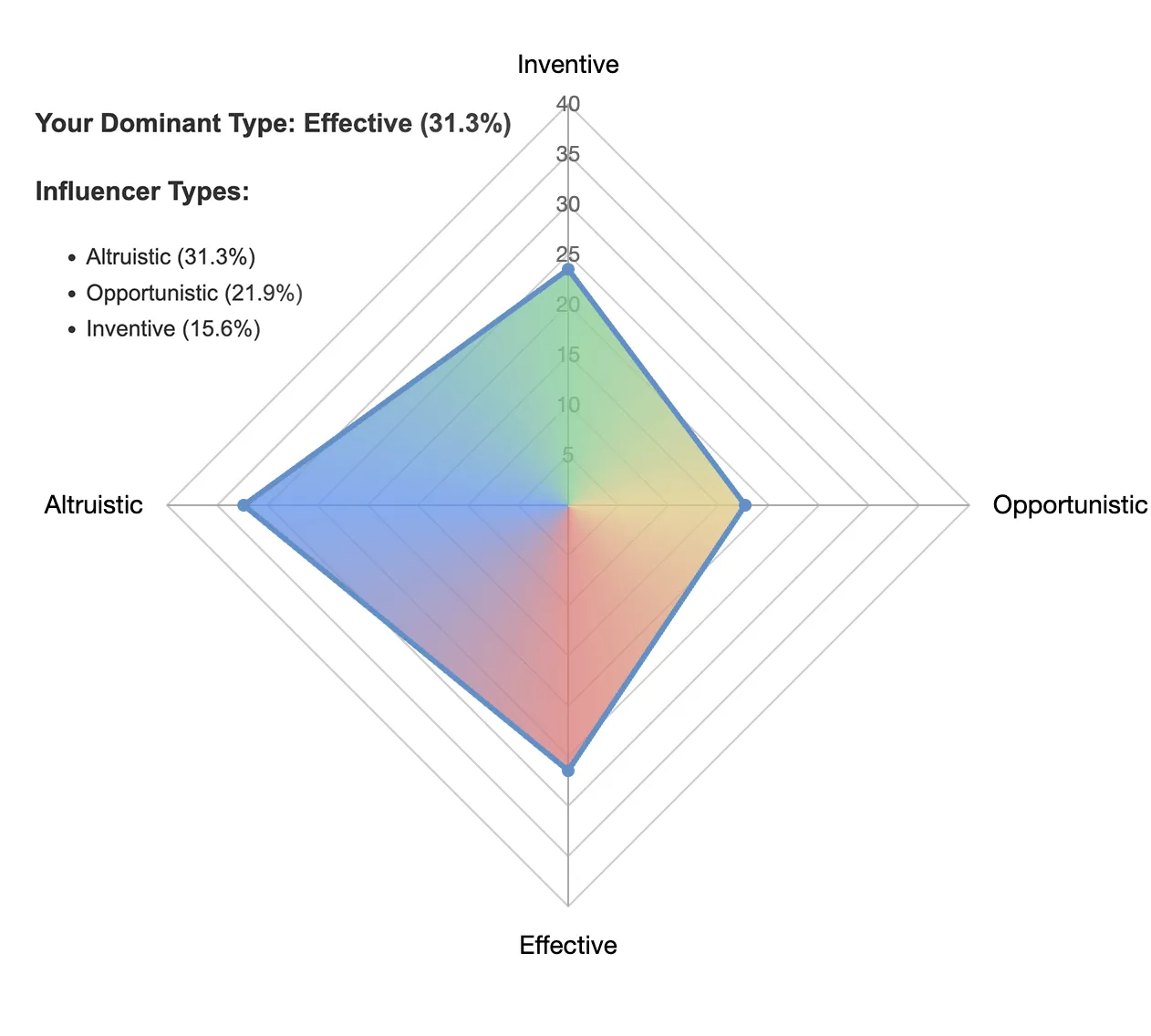
Every successful venture needs full radar chart coverage. The four entrepreneurial types—Altruistic, Effective, Inventive, Opportunistic—map directly to the four business disciplines your company cannot ignore:
- Products & Services (where Problems/Desires meets Solutions/Curiosity)
- Marketing & Retaining (where Problems/Desires meets Knowledge/Skills)
- Operations & Logistics (where Knowledge/Skills meets Time/Money)
- Legalizing & Accounting (where Time/Money meets Solutions/Curiosity)
A venture that only focuses on innovation while ignoring operations fails. A venture that only focuses on service while ignoring profitability fails. You need all four quadrants covered.
Here's where most entrepreneurs get stuck: they assume they need to personally cover the entire chart.
If you're naturally Effective+Altruistic—strong on the left side of the radar chart—you'll feel pressure to "become more Opportunistic" or "develop your Inventive side." You'll take courses on growth hacking. You'll force yourself to think like a disruptor. You'll try to stretch your natural shape to cover the entire circle.
And you'll create massive internal tension in the process.
Tension vs. Weakness: A Critical Distinction
Traditional business advice treats entrepreneurial gaps as weaknesses to overcome. "You're bad at sales? Take a sales course. You're not innovative enough? Read about design thinking. You avoid financial planning? Hire an accountant and force yourself to look at the numbers weekly."
The ETI framework sees it differently. Those gaps aren't weaknesses—they're tensions.
A weakness implies deficiency. Something broken that needs fixing. A personal failing that holds you back.
A tension implies natural pull in different directions. The discomfort you feel when operating outside your dominant drives. The energy drain that happens when you spend too much time on the opposite side of your radar chart.
When an Altruistic entrepreneur struggles with aggressive pricing, that's not a weakness—it's the tension between serving people and maximizing revenue. When an Inventive entrepreneur struggles with execution discipline, that's not a weakness—it's the tension between exploration and systematization. When an Effective entrepreneur struggles with rapid pivots, that's not a weakness—it's the tension between mastery and experimentation.
These tensions don't disappear with training. You can learn skills, but you can't fundamentally rewire your entrepreneurial drives. An Opportunistic entrepreneur can take empathy workshops until their head explodes—they'll still naturally think about systems before people. An Altruistic entrepreneur can study pricing psychology endlessly—they'll still feel uncomfortable charging premium rates.
The tension remains until you stop trying to cover the entire radar chart yourself.
The Solopreneur's Dilemma
Most entrepreneurs start solo. You're the founder, the operator, the salesperson, the accountant, the product developer, and the janitor. You have no choice but to cover all four quadrants yourself.
This works—barely—in the early stages. You push through the tension. You handle the tasks that drain you because nobody else is there to do them. You spend Monday morning on creative exploration (your strength) and Monday afternoon on financial forecasting (your tension zone) and wonder why you're exhausted by Tuesday.
The problem compounds as you grow. The tension zones don't shrink—they expand. More decisions, more complexity, more time required in areas that drain you. You're not building toward sustainability—you're building toward burnout.
This is why the ETI radar chart matters. It shows you exactly which quadrants naturally energize you and which ones create tension. And more importantly, it shows you which complementary types can resolve that tension by naturally covering the opposite side.
How Complementary Partners Resolve Tension
When you partner with someone whose radar chart covers what yours doesn't, something remarkable happens: the tension dissolves.
Not because you've "fixed" yourself or "overcome" your weakness. But because you're no longer forcing yourself to operate in perpetual tension. Tasks that drain you energize your partner. Areas where you struggle are where they excel. And vice versa.
Consider the radar chart patterns:
Left-side dominant founders (Effective+Altruistic) naturally excel at systematic processes, customer relationships, and quality operations—but experience tension around aggressive growth, rapid innovation, and profit-first decisions.
Right-side dominant founders (Opportunistic+Inventive) naturally excel at scalable opportunities, experimentation, and resource efficiency—but experience tension around deep relationships, operational systematization, and mission-driven culture.
Put these types together? Full radar chart coverage. Neither founder operates in constant tension. Both work primarily in their strengths while trusting their partner to cover the opposite side.
Case Study: Covering the Chart as a Team
Sarah (Altruistic+Altruistic) and Marcus (Opportunistic+Effective) launched a workforce training program for formerly incarcerated individuals.
Sarah's radar chart showed extreme left-side coverage. When she operated solo, 30% of her time spent in tension zones (pricing, growth strategy, resource optimization) consumed 60% of her mental energy. Every pricing conversation was agonizing. Every "no" to a participant felt like mission betrayal.
Marcus's radar chart showed strong right-side coverage. He excelled at growth systems and efficiency but struggled to articulate mission or make people-first decisions.
Together? Sarah stopped forcing herself into pricing negotiations—Marcus handled those naturally. Marcus stopped trying to "be more empathetic" with communities—Sarah handled that naturally. The tension didn't disappear from the business (healthy tension creates good decisions), but it disappeared from each individual founder.
Now both operate 90% in their natural zones. The 10% overlap—major strategic decisions—is where productive tension lives. Not internal tension within each founder, but collaborative tension between complementary perspectives.
Identifying Your Tension Zones
Look at your ETI radar chart. Where does your shape show minimal coverage?
Those aren't areas where you're "bad at business." They're areas where you're operating under tension. And tension, sustained over time, is exhausting.
Ask yourself:
- Which business activities drain you even when they're going well?
- Where do you procrastinate not because you lack skill, but because it feels fundamentally misaligned?
- What tasks do you handle competently but resent deeply?
- Which entrepreneurial advice sounds logical but feels impossible to implement?
Those answers reveal your tension zones. And your tension zones reveal what kind of partner you need.
If your radar shows heavy Altruistic+Effective coverage: Partner with Opportunistic or Inventive types who bring growth focus and innovation without requiring you to abandon your systematic, service-driven approach.
If your radar shows heavy Opportunistic+Inventive coverage: Partner with Altruistic or Effective types who bring customer depth and operational excellence without slowing your momentum.
If your radar shows heavy Altruistic+Inventive coverage: Partner with Effective or Opportunistic types who bring execution discipline and scalability without crushing your mission or creativity.
If your radar shows heavy Effective+Opportunistic coverage: Partner with Altruistic or Inventive types who bring purpose and innovation without disrupting your systematic efficiency.
Stop Fixing, Start Pairing
The entrepreneurial advice industry profits from making you feel broken. Buy this course to fix your sales weakness. Hire this coach to fix your operations gap. Read this book to fix your innovation deficit.
Here's the truth: you're not broken. You're experiencing predictable tension from trying to cover an entire radar chart yourself.
Yes, every founder needs baseline competence across all four quadrants. But trying to achieve equal strength in all four creates perpetual tension and mediocre results. The path forward isn't fixing your gaps—it's finding partners whose natural strengths resolve your tensions.
Your radar chart isn't a report card showing where you failed. It's a partnership map showing who complements you.
Want to see your exact coverage and identify your tension zones? Take the Entrepreneurial Type Indicator at entrepreneurialtypeindicator.com. You'll get your full radar chart, your specific subtype, and concrete guidance on which partnership types resolve your tensions while amplifying your strengths.
Because sustainable entrepreneurship isn't about covering every quadrant yourself. It's about building teams that cover the chart together—each founder operating in their strengths, nobody operating in constant tension.
Up Next: The Four Components Test—the diagnostic framework that reveals whether your business idea is actually viable before you invest a single dollar.
The Entrepreneurial Type Indicator (ETI) is the foundation of The Start Squad Academy's STEP Framework—Success Training in Entrepreneurship Program. Built for founders who are done with hype and ready for evidence-based, type-aware guidance that actually works.