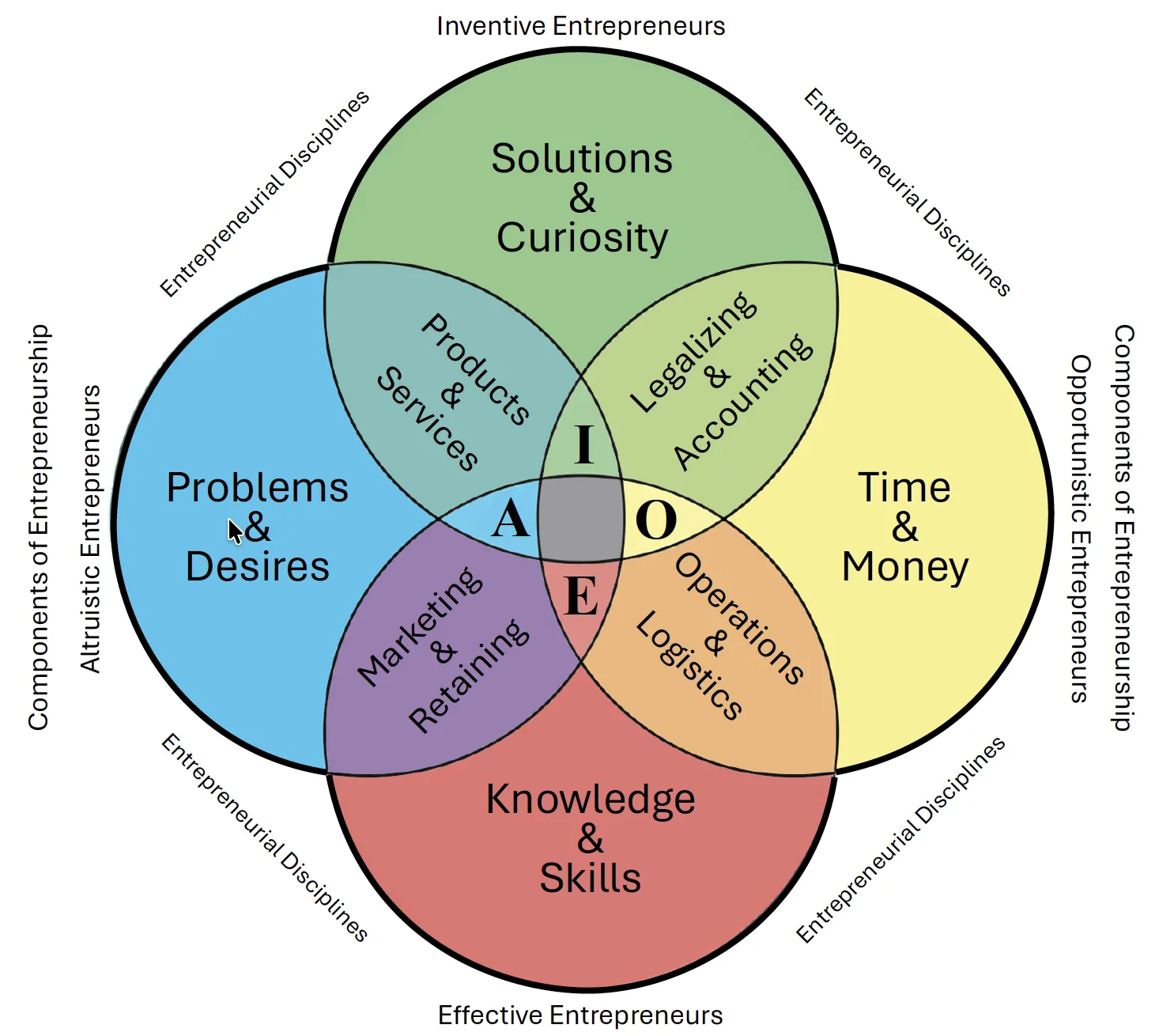
Your business will fail in a predictable place. Not because you're lazy. Not because you're incompetent. But because every entrepreneur has a natural blind spot—and that blind spot corresponds directly to one of four critical areas every venture requires.
Most founders don't realize this until it's too late. They're brilliant at product development but their accounting is chaos. Or they're marketing geniuses whose operations fall apart under load. Or they're operational masters whose offerings never evolve to meet market needs.
Understanding which area you're neglecting—and why—starts with understanding the foundational building blocks of every business.
The Four Components: Your Raw Materials
Before we talk about disciplines, we need to talk about components. Every entrepreneurial venture is built from four fundamental elements:
Problems & Desires — Recognition of unmet needs within markets and communities. What do people actually need? What do they want? Where are the gaps?
Knowledge & Skills — Development and application of mastery for effective value delivery. What do you know? What can you do? How well can you execute?
Solutions & Curiosity — Exploration of novel possibilities to address identified needs. What could we try? What hasn't been done yet? How might we innovate?
Time & Money — Strategic management of finite resources to sustain and grow operations. How much runway do we have? Where should we invest? What can we afford?
Think of these as the four raw inputs every business needs. You can't build anything without some combination of all four. But here's where it gets interesting: these components don't operate in isolation—they overlap.
How Components Overlap to Create Business Domains
These four components don't operate in isolation. They interact. And when two components intersect, they create a professional domain—a specific area of business expertise that requires focused attention.
Think of it like a Venn diagram. Where the circles overlap, new capabilities emerge:
Where Problems/Desires meets Solutions/Curiosity, you get Products & Services—the domain of creating tangible or intangible offerings that markets actually want. You're identifying what people need and exploring how to deliver it.
Where Problems/Desires meets Knowledge/Skills, you get Marketing & Retaining—the domain of communicating value propositions and building lifetime customers. You're connecting your expertise to customer needs.
Where Knowledge/Skills meets Time/Money, you get Operations & Logistics—the domain of organizing systems and processes for efficient delivery. You're applying your capabilities within resource constraints.
Where Time/Money meets Solutions/Curiosity, you get Legalizing & Accounting—the domain of securing financial and legal sustainability. You're managing resources while exploring what's possible within regulatory frameworks.
These four domains—we call them the Four Disciplines of Entrepreneurship—represent every critical business function. Every successful venture needs all four operating effectively.
But here's the problem: most entrepreneurs excel at one or two while barely maintaining the others.
What Each Discipline Actually Involves
Let's get concrete. Here's what these disciplines look like in practice:
Products & Services: Building What People Want
This discipline covers identifying genuine customer needs, developing minimum viable products, iterating based on feedback, creating feature roadmaps, pricing strategy, and quality assurance.
Example task: "Implement systematic customer feedback collection—weekly user interviews, quarterly surveys, usage analytics, support ticket analysis, feature request tracking. Build feedback directly into roadmap prioritization."
Founders who neglect this discipline build products nobody wants or services that don't solve real problems.
Marketing & Retaining: Connecting Value to Customers
This discipline covers audience segmentation, messaging that resonates, marketing channel optimization, sales funnel development, customer retention strategies, and referral systems.
Example task: "Develop comprehensive customer journey mapping—awareness touchpoints, consideration content, decision conversions, onboarding optimization, engagement cadence, retention triggers, referral timing and incentives."
Founders who neglect this discipline have great products nobody knows about or customers who churn after first purchase.
Operations & Logistics: Executing Reliably at Scale
This discipline covers standard operating procedures, workflow optimization, resource planning, quality control, technology infrastructure, and team coordination.
Example task: "Document comprehensive operations manual—company mission and values, organizational structure, standard procedures for core functions, vendor management protocols, technology systems and access, crisis procedures. Update quarterly."
Founders who neglect this discipline experience chaos as they scale—missed deadlines, quality issues, team confusion, and burnout from being the only person who knows how anything works.
Legalizing & Accounting: Ensuring Sustainability and Compliance
This discipline covers entity formation, bookkeeping systems, cash flow management, tax compliance, contract management, and regulatory compliance.
Example task: "Implement daily bookkeeping and weekly financial monitoring—transactions categorized daily, receipts captured immediately, bank accounts reviewed daily, accounts reconciled weekly, rolling 8-12 week cash flow projection updated weekly, accounts receivable follow-up, budget versus actual review."
Founders who neglect this discipline run out of cash unexpectedly, face tax penalties, violate regulations unknowingly, or get sued over poorly written contracts.
Your Type Reveals Your Blind Spot
Here's the pattern most entrepreneurs miss: your entrepreneurial type predicts which discipline you'll naturally neglect.
Altruistic entrepreneurs naturally excel at Marketing & Retaining (building customer relationships) and Products & Services (solving genuine needs). They often neglect Legalizing & Accounting—financial discipline feels at odds with their mission-first approach.
Effective entrepreneurs naturally excel at Operations & Logistics (systematizing everything) and Marketing & Retaining (leveraging expertise). They often neglect Products & Services innovation—"if it's not broken, why fix it?" means they miss market shifts.
Inventive entrepreneurs naturally excel at Products & Services (constant innovation) and Legalizing & Accounting (exploring legal structures). They often neglect Operations & Logistics—systems feel like creativity-killers, so nothing gets documented or systematized.
Opportunistic entrepreneurs naturally excel at Legalizing & Accounting (resource optimization) and Operations & Logistics (efficiency focus). They often neglect Marketing & Retaining—they're too transactional and struggle to build deep customer relationships.
Your blind spot isn't random. It's the predictable result of your natural drives creating tension in specific areas.
Diagnostic: Which Discipline Are You Ignoring?
Answer honestly:
Products & Services: When was the last time you systematically collected customer feedback and used it to improve your offering? Do you have a product roadmap based on real user needs or just your assumptions?
Marketing & Retaining: Do you have a documented customer acquisition strategy? Can you explain your customer lifetime value and acquisition cost? Do customers refer others consistently?
Operations & Logistics: If you got hit by a bus tomorrow, could your business continue without you? Are your core processes documented? Can team members find what they need without asking you?
Legalizing & Accounting: Can you tell me your current cash position and runway without checking? Are your books up to date? Do you know if you're profitable or just revenue-positive?
Whichever question made you uncomfortable—that's your neglected discipline.
The Hidden Cost of Discipline Neglect
Neglecting a discipline doesn't create immediate failure. It creates delayed failure.
Your amazing product (Products & Services) scales to 1,000 customers before you realize your operations (Operations & Logistics) can't handle the volume. Your efficient operations run perfectly—right up until a competitor with better innovation (Products & Services) makes your offering obsolete. Your incredible marketing attracts floods of customers whose payments you're tracking in a spreadsheet (Legalizing & Accounting) until tax season reveals you owe $40K you don't have.
The discipline you ignore today becomes the crisis you face tomorrow.
You Can't Master Everything—But You Can't Ignore Anything
Here's the truth: you don't need to be equally strong in all four disciplines. That's impossible and exhausting.
But you do need all four disciplines functioning at baseline competence. And you need partners whose natural strengths cover your natural blind spots.
The path forward isn't becoming a different type of entrepreneur. It's:
- Identifying which discipline you naturally neglect
- Building baseline systems in that discipline (even if they're simple)
- Finding partners, advisors, or team members who naturally excel where you struggle
- Accepting that some disciplines will never energize you—and that's okay
Your entrepreneurial type shows you where you'll naturally excel and where you'll experience tension. The Disciplines framework shows you what every business needs regardless of your type.
The gap between those two things? That's where you need help.
Want to identify your natural strengths and blind spots? Take the Entrepreneurial Type Indicator at entrepreneurialtypeindicator.com. You'll discover which disciplines align with your drives and which ones require different approaches—or different people.
Because ignoring a discipline doesn't make it go away. It just determines when and how your business fails.
Up Next: From Romanticism to Realism—the entrepreneurship nobody talks about, and why facing these truths early saves your business.
The Entrepreneurial Type Indicator (ETI) is the foundation of The Start Squad Academy's STEP Framework. Learn how to build type-aware businesses that cover all four disciplines at startsquadacademy.com.